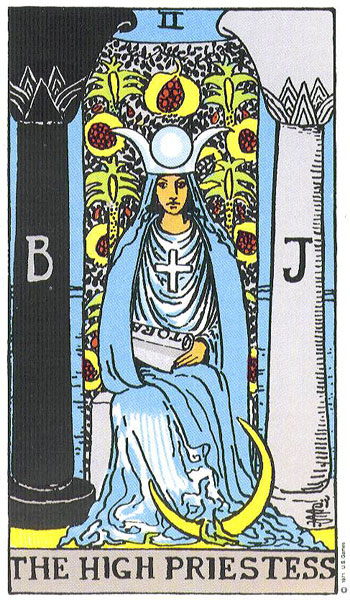
This card can easily be described in great detail, and like many
of the Major Arcana cards, it is chockfull of symbolism that has been
interpreted in numerous ways unique to the reader.
We see a woman completely covered in ceremonial garb sitting
on a stone bench between two pillars in front of a veil. The first thing to
notice is the color scheme—black, white, blue, gray, and even yellow in some
parts. The majority of these colors are associated with the moon, the unknown,
the Mysteries, and hidden knowledge. The two pillars she is seated between are
black on the left and white on the right, symbolizing the polarity of positive
and negative, darkness and light, and so forth. There also are letters on the
pillars—on the black there is a B and the white bears a J.
My best guess is that these letters are a Qabalistic reference, one of many in
the Rider-Waite deck as a whole. A second possible Qabalistic reference in this
card is the priestess’ scroll, which reads “TORA” if
closely looked at. The Torah is the Jewish holy text, and Qabala is a type of
mysticism tied to Judaism.
The veil behind the priestess is also a
very important symbol, as it is not only covered in what look to be
pomegranates, but it appears to be a veil between the astral and physical worlds.
It is closed behind her because the astral worlds are supposed to be secret
save for a select few—only the priestess can access that part of existence, as
displayed by the card because the way she is sitting shows that she is guarding
it; therefore, she is guarding arcane secrets and the unknown because the
unknown is reputed to frighten those who are not ready to make themselves open
to it.
The pomegranates on the veil are one of
the most contradictory parts of this card—not only do they resemble the yoni
(female genitalia) and represent fertility (therefore hinting at female
sexuality), the priestess is, in many sources, celibate; sexless in order to be completely
dedicated to her spirituality/craft/mysticism. Another hint at the
priestess’ celibacy is the veil she is wearing over her hair and topped with
the moon
crown—I connected this to how a nun is celibate and wears a veil and
wimple over her head. The moon crown, I noticed, is reminiscent of a well-known
Wiccan/Pagan/Witchcraft symbol for the Triple Goddess representing the three
stages of a woman’s life. On her bosom is an equal-armed cross, which
could mean many things including balance, sanctity, or even the planetary
symbol for Earth.
Finally, at the feet of the priestess is the crescent
moon, which is a symbol of the feminine, darkness, secrets, the
night, and intuition.

No comments:
Post a Comment